

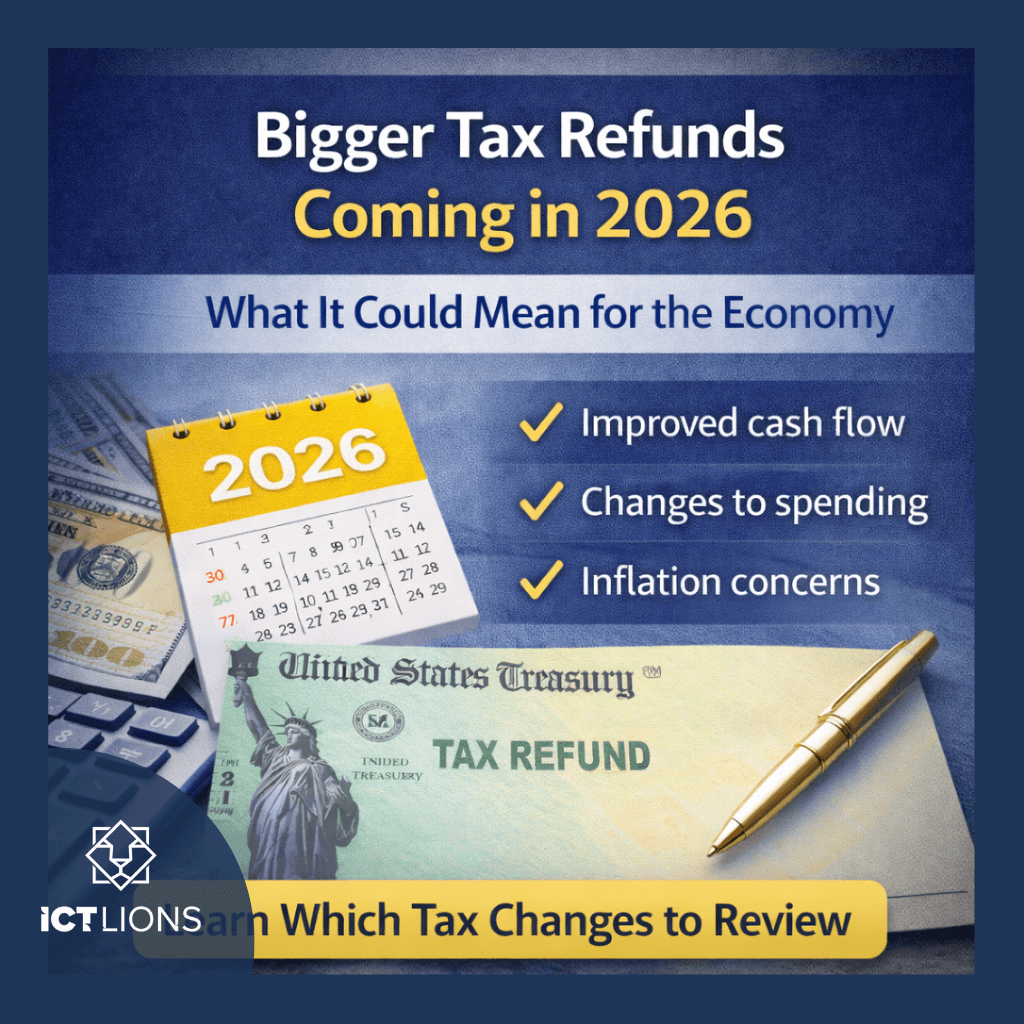
Bigger Tax Refunds Are Coming in 2026 – What It Means for You and the Economy
Due to tax law changes that took effect in 2025 (the One Big Beautiful Bill Act (OBBBA), millions of filers may receive larger-than-usual refunds when they file their returns in early 2026. While this may feel like a welcome surprise, the reasons behind it — and the broader economic effects — deserve closer attention, especially for small business owners and self-employed professionals.
Why Tax Refunds Are Expected to Be Larger in 2026
Several tax provisions enacted for the 2025 tax year lowered individual income taxes — but withholding tables were not updated by the IRS.
That means:
- Paychecks largely stayed the same throughout 2025
- More tax was withheld during the year
- The benefit shows up at filing time, not in weekly or monthly pay
As a result, many taxpayers may receive bigger refunds rather than seeing higher take-home pay.
The IRS is scheduled to began processing individual tax returns on January 26, 2026.
Tax Changes Driving Higher Refunds
The 2025 tax changes included several provisions that directly reduce taxable income or tax owed, such as:
- A larger standard deduction
- A more generous child tax credit
- A higher state and local tax (SALT) deduction limit
- A new $6,000 senior deduction
- New deductions for:
- Auto loan interest
- Certain tip income
- Qualified overtime pay
According to estimates from the Tax Foundation, these provisions reduced individual income taxes by approximately $129 billion in 2025.
Economists expect this to translate into refunds that are 15–20% higher on average compared to recent years.
How Big Are Refunds, Historically?
To put this into context:
- The average tax refund in 2025 was about $3,050
- The IRS issued refunds over 100 million taxpayers
- Roughly 60% of refunds were paid out by late March
Even a modest percentage increase can inject tens of billions of dollars into households in the first quarter of 2026.
Could Bigger Refunds Boost Consumer Spending?
From an economic standpoint, larger refunds may provide a short-term boost to consumption.
However, how refunds are used depends heavily on income level:
- Middle-income households tend to spend a higher share of refunds
- Higher-income households are more likely to save or invest
- Many taxpayers use refunds to pay down debt
Recent surveys show that more than 80% of taxpayers expecting refunds plan to save or reduce liabilities, rather than spend freely.
For small business owners, this matters because:
- Consumer spending affects demand
- Seasonal cash flow may shift
- Refund-driven spending is often temporary
Inflation Concerns: Should We Be Worried?
Some economists have raised concerns that a surge in refunds could:
- Increase short-term demand
- Add pressure to inflation
Others are less concerned, noting that:
- Refunds are not “new money” like stimulus checks
- Supply chains are significantly more stable than during 2020–2022
- Many households will not immediately spend the funds
In short, while refunds may influence spending patterns early in 2026, most analysts do not expect a major inflationary spike driven solely by tax refunds.
What This Means for Small Business Owners
From our perspective at ICT Lions, larger refunds are not just an economic story — they’re a planning issue.
If you’re a business owner or self-employed professional, bigger refunds may signal that:
- Too much tax was paid during the year
- Estimated payments or withholding may need adjustment
- Cash flow planning could be optimized
A refund is not a bonus — it’s your own money returned late.
For many clients, the real opportunity is using 2026 as a reset point to:
- Rebalance withholding or estimated payments
- Improve quarterly cash flow
- Align tax strategy with business growth goals
Final Thoughts
Bigger tax refunds in 2026 may feel like good news — and for many households, they will be. But refunds also reflect how taxes were managed throughout the year.
For individuals and small business owners alike, the smartest move isn’t just waiting for a larger check — it’s understanding why it happened and how to plan better going forward.
Tax season 2026 will reward preparation, not surprises.